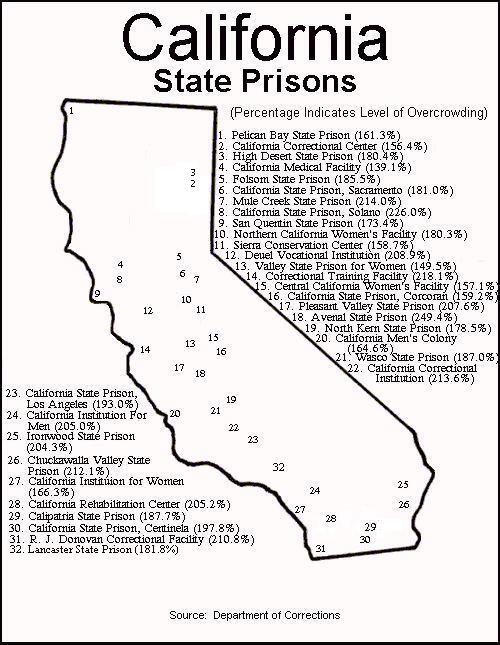
 If that old adage still holds true, then the nation may soon see a gradual backpedaling from the criminal justice policies that have led to wholesale incarceration in recent decades. For the most populous state in the union is on the verge of insolvency — partly because it didn't set aside a rainy-day fund during the boom years; partly because its voters recently rejected a series of initiatives that would have allowed a combination of tax increases, spending cuts and borrowing to help stabilize the state's finances during the downturn; partly because it has spent the past quarter-century funneling tens of billions of dollars into an out-of-control correctional system. Now, as California's politicians contemplate emergency cuts to deal with a $24 billion hole in the state budget, old certainties are crumbling.
Showing posts with label california. Show all posts
Showing posts with label california. Show all posts
6.22.2009
Will it be debtor’s prison for California?
Perhaps, but it now seems as though California will escape this sad fate because, well, because the state can no longer afford to use incarceration as a technique of social and political control. I believe no sensible person would lament this reversal. Nor would they lament the fact that California's fate may also be an omen of those measures additional states will be forced to take in order to manage their budget crises. As Sasha Abramsky reminds us, "As California goes, so goes the nation." She continues by noting that:
If that old adage still holds true, then the nation may soon see a gradual backpedaling from the criminal justice policies that have led to wholesale incarceration in recent decades. For the most populous state in the union is on the verge of insolvency — partly because it didn't set aside a rainy-day fund during the boom years; partly because its voters recently rejected a series of initiatives that would have allowed a combination of tax increases, spending cuts and borrowing to help stabilize the state's finances during the downturn; partly because it has spent the past quarter-century funneling tens of billions of dollars into an out-of-control correctional system. Now, as California's politicians contemplate emergency cuts to deal with a $24 billion hole in the state budget, old certainties are crumbling.
The appalling War on Drugs may become one casualty of this fiscal reckoning. Punitive sentencing laws may be another. Given the significance of the current situation, one might hope that Americans would "just say no" to the carceral system (Foucault) and the pacification techniques it employs.
If that old adage still holds true, then the nation may soon see a gradual backpedaling from the criminal justice policies that have led to wholesale incarceration in recent decades. For the most populous state in the union is on the verge of insolvency — partly because it didn't set aside a rainy-day fund during the boom years; partly because its voters recently rejected a series of initiatives that would have allowed a combination of tax increases, spending cuts and borrowing to help stabilize the state's finances during the downturn; partly because it has spent the past quarter-century funneling tens of billions of dollars into an out-of-control correctional system. Now, as California's politicians contemplate emergency cuts to deal with a $24 billion hole in the state budget, old certainties are crumbling.

5.30.2009
One hand gives, the other takes away
Michael Perelman identifies here what must be considered an instance of political Darwinism in the Obama and Bush crisis management efforts:
During the Vietnam War, a U.S. soldier seems to have anticipated the spirit of the current economic policy, explaining: "we had to destroy the village in order to save it." The difference today is that while the government destroys villages of the working classes, it is devoting enormous [sic] to improve the castles of the rich.
Anyone can see the care and feeding of bankers and financiers, while treating much of the rest of the economy with an iron fist.
The problem is compounded because alongside the federal stimulus, funding for state and local government is falling off the cliff, in effect, neutralizing much of the stimulus. This contradiction in economic policy is nothing new.
These policies would be politically Darwinistic since the hand which effects the destruction of the misfits can be easily seen by anyone who cares to look.
5.28.2009
There is plenty of money for empire while California collapses
Robert Scheer worries about the failure of the Obama regime to address directly and with a workable blueprint for solving California's budget crisis. As well he should given the attack California now plans to make on its safety-net and education system:
Bail out the banks, but not the 500,000 poor families with children served by the CalWorks program, which will be dismantled, or the 928,000 children covered by the Healthy Families program, slated for oblivion.
At a time when the feds are spending with such abandon in an effort to stimulate the economy why is it tolerable to leave states in a position where they are forced to fire teachers? As the Los Angeles Times reported: "Schwarzenegger has proposed slashing state spending on education by $3 billion to help close the budget gap, and the state would pay dearly for canceling classes, firing instructors, cutting class days and shortening the school year, experts said." How can there be federal funds readily available for banker bonuses but not to keep teachers in the classroom with their students? It must have been the kids who caused the meltdown.
Scheer could have also included the money wasted on America's national-security and surveillance state and the empire that state advances.
5.26.2009
California here we come….
Krugman opines:
…the California [fiscal and political crisis] still has me rattled. Who would have thought that America's largest state, a state whose economy is larger than that of all but a few nations, could so easily become a banana republic?
Krugman — rightly — blames the infamous Proposition 13 and, transitively, every bit of the Reaganite foolishness that followed. The greater danger the California crisis prefigures, a danger applicable to the country as a whole, could be more easily managed at the federal level but for the rightwing economic thinking that still pervades the land. The key battle remains political in character.
Subscribe to:
Posts (Atom)


 Posts
Posts


