


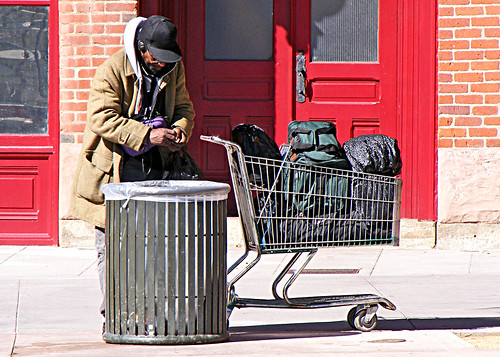
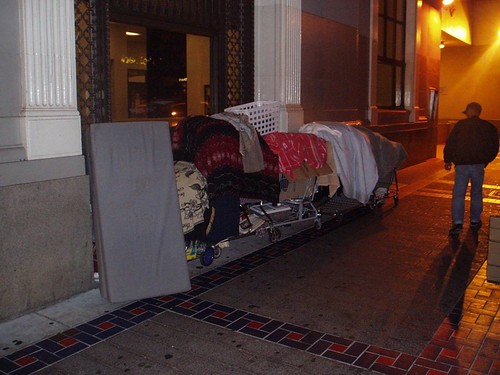
With the term normalize I wish to suggest that the current economic crisis is now transforming an enduring but largely disavowed phenomenon (homelessness) into something people can rightly anticipate, accept as inevitable and even fear as a possible fate they may suffer. The media have a role to play in this transformation, according to Rose Aguilar:
Over the past few months, reporters from around the world have flocked to the now-famous tent city in Sacramento, Calif. When they find out that 55-year-old John Kraintz has been living in a tent for almost seven years, they turn around and walk away.
"They don't want to talk to me," he says. "They're searching for people who just lost their homes. It's kinda tough to lose a home when you've never owned one. Sorry, but most of the people here have been homeless for a long time."
…
Kraintz and so many other homeless people like him have been living in scattered Sacramento encampments for years, but they've been largely ignored and hidden from public view. That is, until Lisa Ling, a reporter with the Oprah show, came to town in late February to focus on what Oprah Winfrey called the "new faces" of homelessness.
Myopia such as can be seen here is just one consequence that issues from the common distinction drawn between the "deserving" and "undeserving poor." Poverty — and thus homelessness — is but one of the essential features which characterize the American political economy. It was never acceptable because it was never unavoidable.
Journalist Chris Hedges, drawing upon his recent phone interview with Dennis Kucinich, discusses the treachery of the Democratic Party as it promotes the interests of its paymasters, Wall Street. He pulls no punches when listing some of the Party's many betrayals of the common folk. But he is especially scathing in his depiction of Barak Obama and the role Obama played during to get the Paulson Plan through Congress. Hedges on Obama
Obama arrived on the Senate floor Brutus-like to thrust a knife into the back of the working and middle class. He lobbied hard for the bill. He did so, according to some who met with him on Capitol Hill, because he feared that if he opposed the bailout and it triggered a market collapse it could cost him the election. Better to placate the thieves on Wall Street than stand up for the masses of enraged and swindled citizens.
Obama's betrayal is the betrayal of the Democratic Party.
And
Obama's support for the bailout…is his most egregious betrayal. He had a brief, shining moment to prove he could lead, to capitalize on a popular revolt that cut across the political spectrum. He never attempted to address or mobilize the aspirations and passions of the vast majority of Americans. He was as craven, servile and cowardly as the party he represents. He returned to the campaign trail after Friday's vote as a slick and polished sales representative for our corporate state, telling us to calm down and accept the inevitable.
The last passage quoted depicts with some clarity the impulse which makes the Democratic Party a dead end for movements struggling to achieve a program of radical reform. The Democratic Party works only for those organizations and interests that pay for the services rendered by the Party. Wall Street pays well, of course. Its members are highly organized, politically effective. The rest of America? Not much money or organization may be found there. Most citizens individually and collectively lack the capacity to buy a Congress or a President. Therefore I would say that it was not that Obama failed to lead America's frightened and disenchanted citizens in their struggle with the plutocrats; rather, I believe Obama led them to the land of political insignificance and, in the end, personal despair. That is, after all, a key part of his task as a major party presidential candidate: To lead the defeated to new defeats. That is the intrinsic betrayal of this kind of politics. It kills hope.




 Posts

