Showing posts with label depression. Show all posts

6.29.2010

Do you feel depressed?

If you do, it's not you…

A worried Paul Krugman issues a warning to his readers and the public at large:

We are now, I fear, in the early stages of a third depression [the two past depressions were the "Great Depression" of the 1930s and the "Long Depression" of the late 1800s]. It will probably look more like the Long Depression than the much more severe Great Depression. But the cost — to the world economy and, above all, to the millions of lives blighted by the absence of jobs — will nonetheless be immense.

And this third depression will be primarily a failure of policy. Around the world — most recently at last weekend's deeply discouraging G-20 meeting — governments are obsessing about inflation when the real threat is deflation, preaching the need for belt-tightening when the real problem is inadequate spending.

Krugman thus believes the actual cause of this potential depression is the political supremacy of fiscal conservative dogma over all efforts to support demand during a time of massive and unemployment, unemployment that may be chronic. In other words, Krugman believes the deficit hawks have defeated the proponents of stimuli in their political battle over economic policy. This, he believes, is a disaster that stands as a precondition for the next global depression.

Update

Chris Hayes and Dean Baker discuss Krugman's take on the current situation:


Last updated on June 29, 2010 at 12:02 pm

7.04.2009

Apart from the effects left behind by the abuse

Pam Martens asserts:

With the sad passing of Michael Jackson, the King of Pop, at age 50 on June 25, another fiction of America's mega wealth was laid to rest: even those living in gated mansions in LA are dying a little each day from debt stress.
From the U.S. Government to the Queen of England to the state house of California, to the millions of homes on both sides of the Atlantic with foreclosure notices nailed to the front door, a good chunk of the globe shares Michael Jackson's lifestyle: too much spending, too little income, too much stress from worrying about it.

6.17.2009

Well, shit…..

William Pesek of Bloomberg tells us that:

Two Japanese men are detained in Italy after allegedly attempting to take $134 billion worth of U.S. bonds over the border into Switzerland. Details are maddeningly sketchy, so naturally the global rumor mill is kicking into high gear.
The implications of the securities being legitimate would be bigger than investors may realize. At a minimum, it would suggest that the U.S. risks losing control over its monetary supply on a massive scale.

(The original news report may be read here. Additional coverage by the same source can be read here.)

Indeed. On the other hand, they may be forgeries. And who, after all, would want hundreds of billions of dollars of worthless bonds?

The trillions of dollars of debt the U.S. will issue in the next couple of years needs buyers. Attracting them will require making sure that existing ones aren't losing faith in the U.S.'s ability to control the dollar.

The dollar is, for better or worse, the core of our world economy and it's best to keep it stable. News that's more fitting for international spy novels than the financial pages won't help that effort. It is incumbent upon the U.S. Treasury to get to the bottom of this tale and keep markets informed.

Assuming the bonds are legitimate, the next question hones in on who could or would have this kind of largess to dump? The list is short:

Other than the U.S., China or Japan, no other nation could theoretically move those amounts. In the absence of clear explanations coming from the Treasury, conspiracy theories are filling the void.

Given the lack of hard and sure answers, I suppose the conjectures flooding the void where the truth ought to reside could be considered as nothing better than conspiracy theories. Yet are they "conspiracy theories" as that term is normally understood when they refer to actual conspiracies in action?

Update (6.19.2009):

Yesterday, the US Treasury declared the bonds fakes (see this, this and this).

6.15.2009

Did someone mention an economic recovery

If so, the he or she did not rely upon the work of Barry Eichengreen and Kevin O'Rourke to make this claim. These two economists recently concluded that the world economy is:

…tracking or doing even worse than the Great Depression, whether the metric is industrial production, exports or equity valuations. Focusing on the US causes one to minimise this alarming fact. The "Great Recession" label may turn out to be too optimistic. This is a Depression-sized event.
That said, we are only one year into the current crisis, whereas after 1929 the world economy continued to shrink for three successive years. What matters now is that policy makers arrest the decline.

3.07.2009

The Obama stimulus appears too small

To the astonishment of the Republican obstructionists

This claim appeared in a recent Washington Post report (see also this, this and this). It was not wholly unexpected since some liberal critics of the stimulus program long-believed the bill should have been larger. The proximate cause of the shortfall: The increasing unemployment rate relative to the unemployment rate assumed by the planners who crafted the stimulus bill. The greater unemployment entails a decrease in demand and thus a decrease in GDP, tax revenue, etc. Moreover, a concern with the size of the stimulus crosses party lines. Martin Feldstein, an economic conservative, weighs in:

The massive downturn in the US economy will last longer and be more damaging than previous recessions because it is driven by an unprecedented loss of household wealth. Although the fiscal stimulus package that US President Barack Obama recently signed will give a temporary boost to activity sometime this summer, the common forecast that a sustained recovery will begin in the second half of the year will almost certainly prove to be overly optimistic.

In other words, the stimulus is inadequate to address the problems it was meant to resolve. Now that Feldstein has made the gravity of the situation clearer, he goes on to predict that "A second fiscal stimulus package is therefore likely." More importantly, the next stimulus program:

… will need to be much better targeted at increasing demand in order to avoid adding more to the national debt than the rise in domestic spending. Similarly, the tax changes in such a stimulus package should provide incentives to increase spending by households and businesses.

Briefly put, Feldstein wants a stimulus program that stands a chance of working! This, oddly enough, is a radical idea when made by an American for the American economy!

1.10.2009

Will it be effective?

The New York Times wonders if Obama's stimulus will work as a remedy to the depression given the President-elect's clear desire to achieve duopoly-wide support for his program.

The looming question, however, is: Does Washington have the stomach and the resources to design and implement a feasible recovery program which gives pride of place to a reindustrialization strategy, developing eco-friendly forms of production, distribution and consumption as well as restructuring the economy in general.

1.09.2009

Recession or depression?

Writing in the New Republic, John Judis suspects that the crisis is a depression:

We may not simply be facing a steep recession like that of the early 1980s, from which we can extricate ourselves in a year or two, but something resembling the Great Depression of the 1930s. For starters, the current crisis is global, which means that one part of the world can't lift the other out of its misery; everyone will go down together, which is what happened in the 1930s. Secondly, the downturn has combined an unusual decline in the real economy — employment in durable-goods manufacturing fell by 21.9 percent from 2000 to 2008 — with a financial crash precipitated by the bursting of the housing bubble. The bubble resulted from an attempt to sustain growth and employment in the face of an underlying decline, which, too, is what happened in the late 1920s.

Peter Morici also believes the crisis is a depression:

The challenges facing President-elect Barack Obama could not be clearer. The current economic slowdown has two structural causes — bad management practices at the large money center banks and the huge foreign trade deficit. These problems are not self-correcting.

The economy will not recover without fundamental changes in banking and trade policy. A large stimulus package, though necessary, will only give the economy a temporary lift but then unemployment will rise again and continue at unacceptable levels indefinitely without successively larger stimulus packages and huge federal budget deficits. The economy is a depression, not a recession.

Both propose economic restructuring as the only feasible remedy to the crisis. When the implications are drawn from their arguments, both seem to suggest that any successful redevelopmental program will have reindustrialization is a necessary condition.

The real issue: Will the Obama administration have the political and economic resources it will need to realize these reforms.

11.08.2008

Some crisis links (11.8.2008)

Writing in the Nation, Robert Polin states the obvious:

The recession is certainly here, so the question now is how to diminish its length and severity. A large-scale federal government stimulus program is the only action that can possibly do the job.

His plan:

Recessions create widespread human suffering. Minimizing the suffering has to be the top priority in fighting the recession. This means expanding unemployment benefits and food stamps to counteract the income losses of unemployed workers and the poor. By stabilizing the pocketbooks of distressed households, these measures also help people pay their mortgages and pump money into consumer markets.

Beyond this, the stimulus program should be designed to meet three additional criteria. First, we have to generate the largest possible employment boost for a given level of new government spending. Second, the spending targets should be in areas that strengthen the economy in the long run, not just through a short-term money injection. And finally, despite the recession, we do not have the luxury of delaying the fight against global warming.

To further all these goals we need a green public-investment stimulus. It would defend state-level health and education projects against budget cuts; finance long-delayed upgrades for our roads, bridges, railroads and water management systems; and underwrite investments in energy efficiency — including building retrofits and public transportation—as well as new wind, solar, geothermal and biomass technologies.

Briefly put, Polin believes that the best possible stimulus program will, if effective, conserve the lives and well being of those individuals most harmed by the crisis, reindustrialize an American economy gutted by finance capital and the Pentagon, refurbish the decaying American landscape and, most importantly, begin to transform the American economy from a system based on resource waste, wealth and income polarity and imperial exploitation to as system that is more ecologically and socially sound.

Ironically, Polin defends his plan, in part, by comparing it to the Reagan stimulus of 1983-4, which was modestly successful in resolving the early 1980s recession. But Polin's plan will intentionally avoid Reagan's Military-Keynesian and trickle down components. It is right to avoid the Reagan strategy since the long and consistent use of the Reagan strategy has produced the current economic crisis.

"This is no time to be timid," as Polin rightly asserts. He hit the mark because Americans will not have too many political opportunities to retool the economy and put the country on a sounder economic base.

Despite the economic crisis, business leaders are looking with suspicion at the pending Obama presidency, according to Business Week. And yet they also find themselves indulging in the personality cult forming around the President-elect:

One notable irony about CEOs and Obama: When the bosses talk of the President-elect, they often invoke Roosevelt. "We need a very, very strong leader, almost like FDR," says Garo H. Armen, CEO of New York-based Antigenics (AGEN), a biotech startup. "He needs to put in place an FDR effect," says Dow Chemical (DOW) Chief Executive Andrew N. Liveris. FDR often antagonized business, but he electrified the nation with his decisiveness. Business executives, like many other Americans, are waiting anxiously to see what FDR effect Barack Obama can produce.

In any case, the President-elect recently pledged to implement a stimulus program as soon as possible (see this, this, this and this).

11.07.2008

Some crisis links (11.7.2008)

They're depressing….

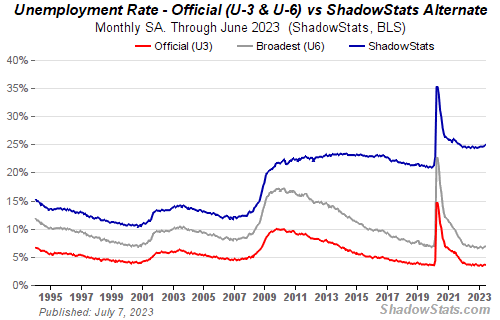
Jobs became scarcer in October, according to reports (see this, this, this and this). Unfortunately the employment news is grimmer than the latest official report lets on. The unofficial but likely more accurate unemployment rate is about double the official rate, according to Shadow Government Statistics:

Chart of U.S. Unemployment

Ford Motor Company continues to hemorrhage cash, according to official and unofficial reports (see this, this, this and this). General Motors and Chrysler are also treading water and should mimic Ford's troubled story when they release their latest earnings reports.

The world stands before another food crisis, according to the Food and Agriculture Organization of the United Nations (here) and the Financial Times (via Naked Capitalism). The global financial crisis will be the proximate cause of the food crisis, according to the FAO report.

And, as one would expect in an economic environment characterized by institutional decay and a global crisis, retail sales have again plummeted (see this).

Some encouraging news: Writing for the Wall Street Journal, Jeffry Shapiro whines:

It seems that no matter what Mr. Bush does, he is blamed for everything. He remains despised by the left while continuously disappointing the right.

But this good news is not the best news possible. The best possible news: Congress impeaches Bush and Cheney; the two are then sent to be tried for the War Crimes they committed by the International Criminal Court at The Hague.